

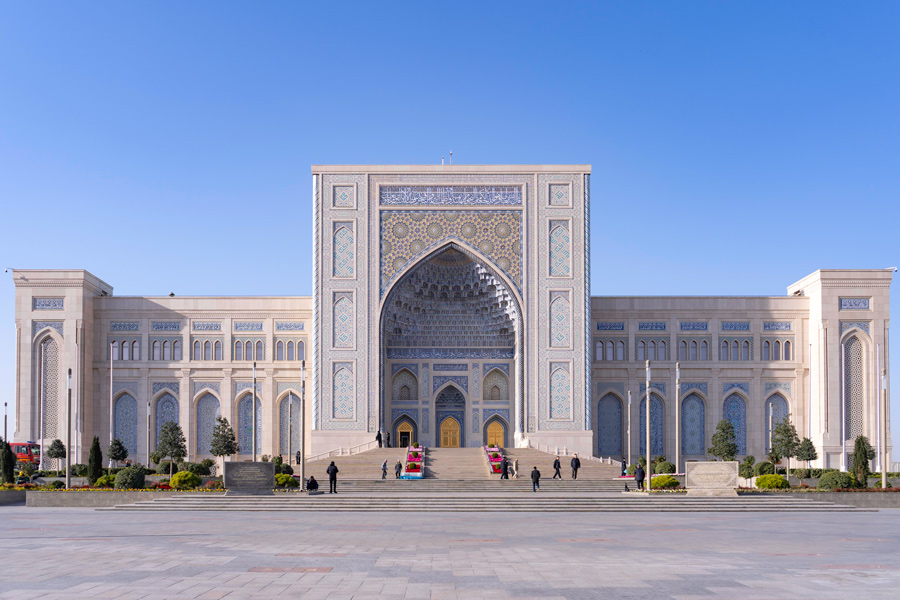
Address: 47 Karasaray Street, Tashkent
Opening hours: daily, 09:00–18:00
The Islamic Civilization Center is one of Uzbekistan’s most ambitious cultural projects of the 21st century. Conceived not simply as a museum but as a major scientific and educational complex, it brings together the heritage of many centuries with modern technology. Beneath the building’s vast dome lies around 15,000 m² of exhibition space. At the heart of the complex is one of the most revered relics of the Islamic world – the ancient 7th-century Quran of Caliph Uthman. The center is also conveniently located for visitors exploring Tashkent, standing next to the well-known Khazrati Imam complex.
History of Creation
The idea of establishing the Islamic Civilization Center was announced in 2017 by the President of Uzbekistan, Shavkat Mirziyoyev. The project was intended to create a single space that would clearly present the region’s contribution to the development of world science and culture, while also serving as a platform for research and education.
Construction continued from 2017 to 2025 and involved hundreds of architects, engineers, craftsmen, and restorers. The architecture of the complex draws inspiration from Uzbekistan’s historic cultural centers – Samarkand, Bukhara, Khiva, Kokand, and Termez. Echoes of these cities appear in the overall composition of the building and in the decorative design of its facades.
As the project developed, international research institutions, museums, and cultural organizations joined the initiative. Rare manuscripts and artifacts were returned to Uzbekistan and added to the growing collection of the center. The complex officially opened on March 17, 2026.
Exhibition
The museum collection of the Islamic Civilization Center includes more than 2,000 exhibits, ranging from everyday objects and tools to manuscripts, books, archaeological discoveries, and works of decorative and applied art. The exhibition is organized into four thematic halls: Pre-Islamic Heritage, First Renaissance, Second Renaissance, and New Uzbekistan. At the center of the layout lies the Quran Hall.
Pre-Islamic Heritage
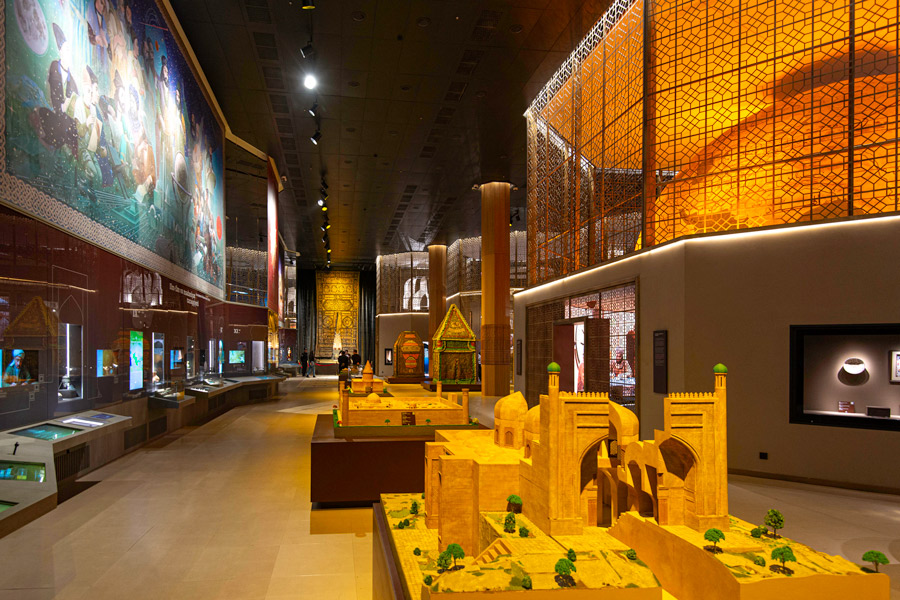
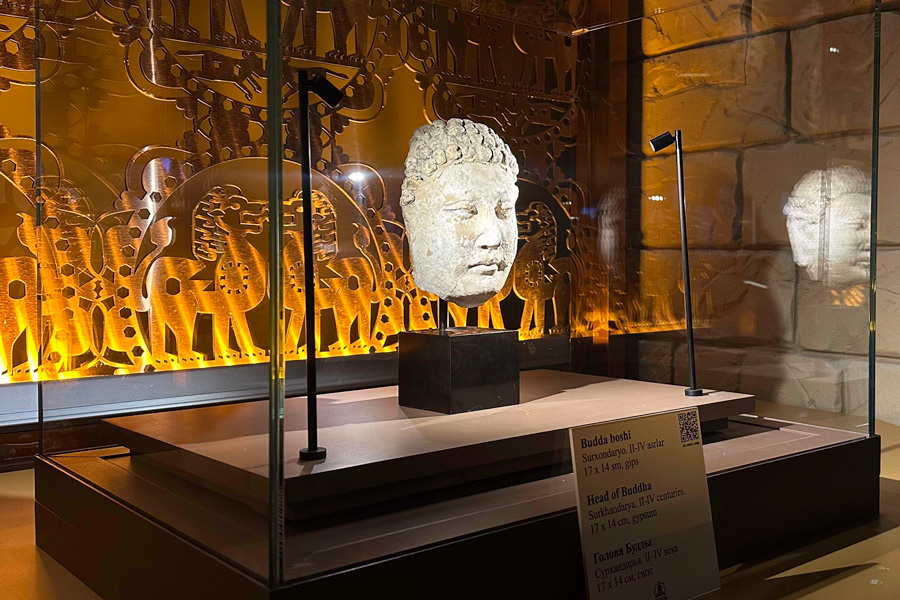
This hall forms the starting point of the exhibition and introduces the early history of the region, covering the period from the earliest settlements to the 7th century. Among the displays are archaeological finds, petroglyphs, ritual objects, and examples of early writing.
One of the hall’s most striking features is the long “Wall of Civilizations”, decorated with bas-reliefs and multimedia installations. It illustrates how the ancient regions of Khorezm, Bactria, and Sogdiana were connected to the wider trade and cultural networks of the ancient world.
The First Renaissance
The second hall focuses on the 8th–13th centuries, a period of remarkable intellectual and cultural development in Central Asia. During these centuries, scholars such as al-Khwarizmi, al-Farghani, Ibn Sina (Avicenna), and al-Biruni produced works that shaped the development of mathematics, medicine, astronomy, and other sciences. Their writings were later translated into Latin and circulated widely in medieval Europe.
The exhibition presents ancient coins, manuscripts, architectural models, jewelry, and objects of applied art. Multimedia elements, including digital reconstructions and animated representations of historical figures, help illustrate the scientific achievements of the period.
The Second Renaissance
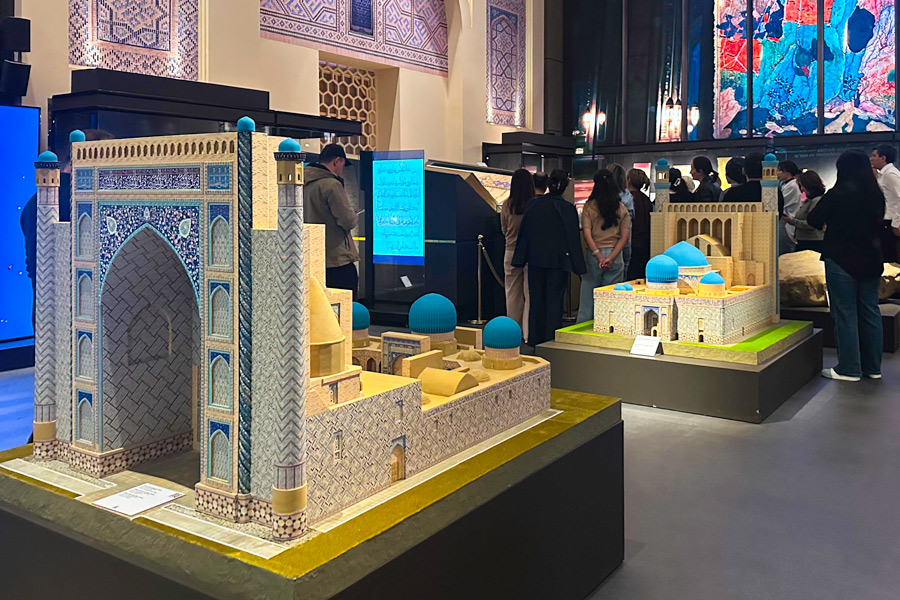
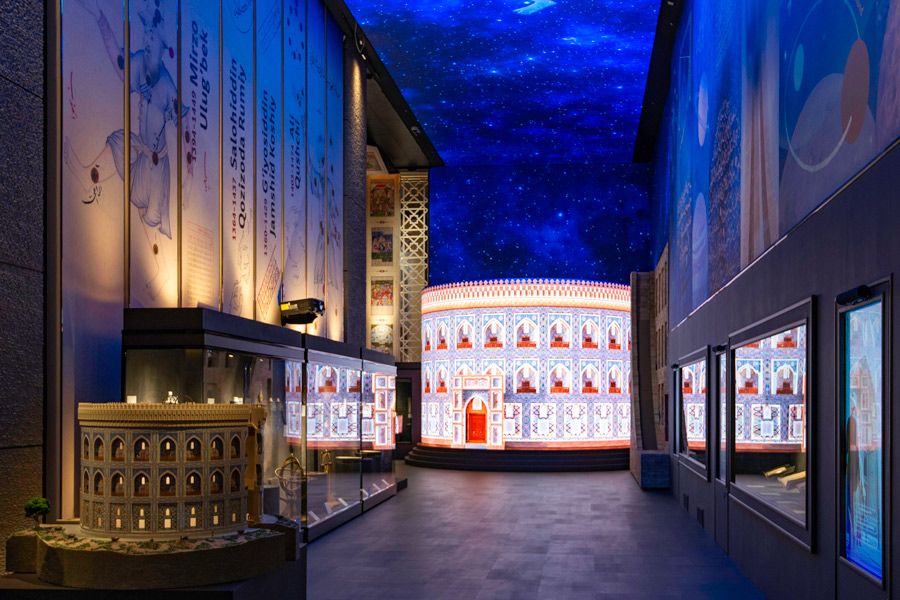
The third hall is dedicated to the 14th–16th centuries, the era of Amir Temur (Tamerlane) and the Timurid dynasty. During this time, Samarkand emerged as one of the most influential cultural centers of the region.
Visitors can see models of architectural landmarks such as the Bibi-Khanym Mosque, the Gur-Emir Mausoleum, and Ulugh Beg’s Observatory. The exhibition also highlights the literary works of Alisher Navoi and presents Ulugh Beg’s famous star catalog. Multimedia displays explain the development of astronomy, architecture, poetry, and literary culture during the Timurid period.
Modern Uzbekistan
The final historical hall focuses on contemporary Uzbekistan. Its displays explore the country’s recent reforms, educational and scientific programs, and the expansion of international cultural cooperation. Modern technology plays a prominent role here. OLED screens, VR headsets, and interactive displays allow visitors to explore the themes of the exhibition in greater depth. In many ways, the building itself becomes part of the narrative – symbolizing the effort to preserve the region’s rich cultural heritage while presenting it through modern technological possibilities.
The Quran Hall
At the heart of the Islamic Civilization Center is the Quran of Caliph Uthman, one of the oldest surviving manuscripts of the Muslim holy book. The manuscript dates back to the 7th century and is associated with a long and complex historical journey.
The original manuscript is displayed under protective glass and cannot be photographed or closely approached. However, reproductions of its pages and detailed multimedia materials allow visitors to study the text and learn about its history. The hall also displays other handwritten Qurans from different historical periods. Before the opening of the Islamic Civilization Center, the Uthman Quran was preserved in the nearby Mu’yi Mubarak Madrasa.
Beyond the Exhibition
The complex extends well beyond the museum galleries. On the second floor, visitors will find a large library containing thousands of printed and digital publications. Researchers and students can work with digital copies of manuscripts and consult rare texts.
The center also houses a manuscript restoration laboratory, conference halls, temporary exhibition spaces, and a Children’s Museum. Additional facilities include a café, a souvenir shop, and several recreation areas for visitors.
Together, these elements make the Islamic Civilization Center more than a museum. It offers a broad introduction to the history and culture of Uzbekistan and highlights the region’s contribution to world science and art. Exploring the four historical halls and the Quran Hall usually takes two to three hours, making the center a meaningful starting point for discovering the cultural heritage of the country.