

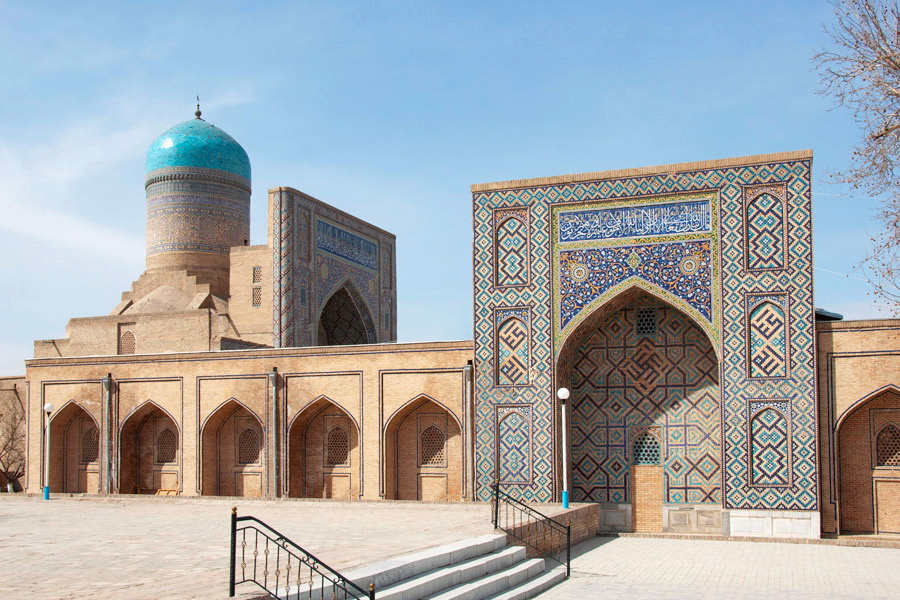
The Khodja-Akhrar Ensemble is one of the most significant religious landmarks in Samarkand. It houses the mausoleum of the revered spiritual leader and statesman Nasir ad-Din Ubaydullah ibn Shashi, who became known to the people as Khodja-Akhrar – a name that can be interpreted from Persian and Uzbek as “teacher of freedom”, reflecting his wisdom and insight. A prominent Sufi sheikh, Khodja-Akhrar was deeply respected for his teachings, which emphasized purification, self-discipline, and an inner connection with God. Khodja-Akhrar was widely known for his generosity and compassion toward ordinary people. He actively supported charitable initiatives, funded the construction of mosques, madrasahs, and irrigation systems, and sought to improve the lives of those in need. Regarded as a defender of the poor and oppressed, his popularity and influence extended far beyond religious circles.
History
The ensemble traces its origins to the second half of the XV century, when a khanaka (Sufi hospice) was built to accommodate pilgrims and preachers. The area was enclosed by a high wall, and opposite the entrance stood a traditional hauz (water reservoir) used for collecting drinking water. In the XVII century, the nearby Nodir Divan-Begi Madrasah was added, followed two centuries later by a winter mosque. Although the original khanaka has not survived, historical records show that some of its elements were later incorporated into the madrasah and mosque, preserving the spiritual essence of the original complex.
After Khodja-Akhrar’s death in 1490, he was buried beside the khanaka, and a mausoleum was soon erected over his grave. The tomb is marked by a massive stone slab adorned with elegant Arabic calligraphy – an exquisite example of Islamic epigraphy and a true masterpiece of religious art.
The Khodja-Akhrar Ensemble suffered extensive damage from several major earthquakes in the XIX and XX centuries. The mosque’s dome collapsed, much of the original decorative detail was lost, and the entrance portal shifted off its vertical axis by nearly a meter. These events significantly altered the ensemble’s appearance.
Fortunately, a comprehensive restoration effort – guided by XIX-century archival photographs – enabled specialists to reconstruct the ensemble as close as possible to its original form.
What You’ll See Today
Today, the Khodja-Akhrar Ensemble includes the Nodir Divan-Begi Madrasah – often called the “mirror of the Sherdor Madrasah” on Registan Square due to its similar decorative style – alongside the winter and summer mosques, a minaret, and a traditional columned iwan. The complex remains a peaceful and secluded space, perfect for quiet reflection and leisurely exploration. The shade of ancient plane trees and the subtle beauty of traditional ornamentation make this a site of both spiritual and architectural significance.
For those interested in Sufism and Central Asia’s spiritual heritage, the Khodja-Akhrar ensemble is an essential stop. It offers not only a deep connection to the region’s religious traditions, but also a chance to experience the serenity and enduring legacy of Samarkand’s sacred spaces. A visit here enriches one’s understanding of Eastern culture and offers a moment of peace in a place that has welcomed pilgrims and seekers for centuries.