

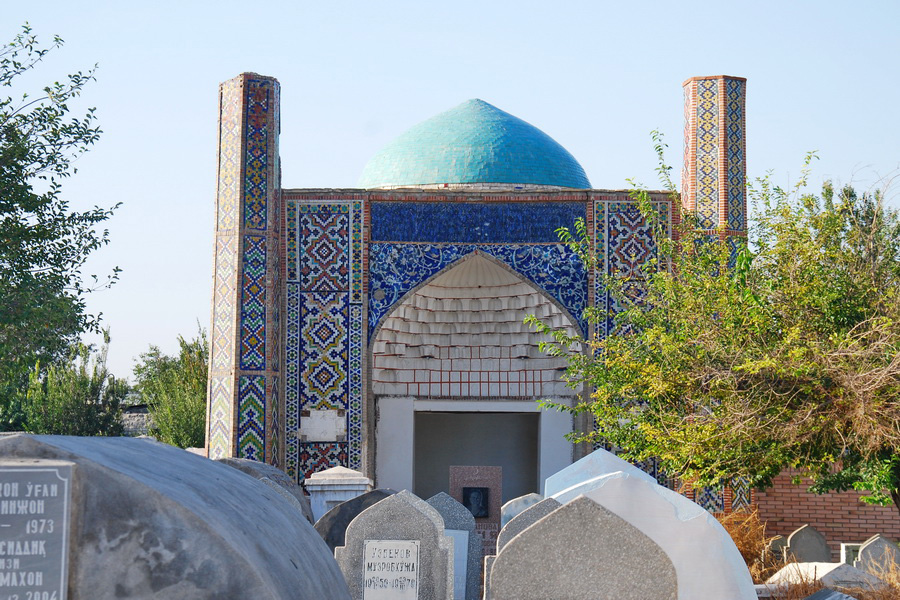
The Madari Khan Mausoleum is a XIX-century tomb and the burial place of the mother of Umar Khan, ruler of the Kokand Khanate. The mausoleum holds great historical significance, as it is linked to influential political figures: Umar Khan, known as a patron of science and the arts, and his wife Nodira, who became a revered poetess and one of the most enlightened women of her era.
History
The Madari Khan Mausoleum appeared in the centre of Kokand in 1825, following the death of Umar Khan’s mother, a woman deeply respected by the population. The tomb above her grave was commissioned by the emir’s wife, Nodira. Its construction served as a gesture of remembrance and profound respect for the khan’s mother, who, according to legend, possessed a strong character and considerable influence at court. She is remembered for her wisdom and maternal guidance.
Nodira’s fate was tragic. The mid-XIX century was marked by fierce rivalry between the Kokand and Bukhara khanates, each striving for dominance in the region. In 1842, as a result of intrigues organized by the Bukhara emir Nasrullah, Nodira and her two sons were captured and executed. This tragedy deprived the Kokand Khanate of a key political figure and influenced subsequent historical events, contributing to the khanate’s eventual collapse.
Nodira’s remains were laid to rest in the Madari Khan Mausoleum, and over time, a small necropolis grew beside it, where the female descendants of Kokand’s rulers were buried. Her sons were interred in the Dakhma-Shakhon mausoleum nearby, which also houses the tomb of Umar Khan himself.
Architecture
The Madari Khan Mausoleum is a striking example of Islamic architecture enriched with decorative elements characteristic of Kokand. The structure features a portal-domed layout with two faceted minarets adorned with colourful tiles arranged in intricate patterns. The entrance portal (peshtok) is richly decorated with vibrant tilework forming a unified panel of traditional Uzbek motifs. The arched niche is crafted using the muqarnas technique, an ornamental method in Eastern art that creates sculptural, honeycomb-like forms. Inside, the mausoleum’s dome stands out for its refined gold and deep blue paintings, with a spiral design converging at the centre - a symbolic representation of the connection between Heaven and God.
The Madari Khan Mausoleum is not merely an architectural landmark, but a living testament to history embodied in stone and ornament. Its walls preserve the spirit of the era, reflecting the former grandeur of the Kokand Khanate. Today, the tomb remains a place of quiet contemplation, where past and present meet, reminding visitors of enduring values: respect for family, reverence for ancestors, and love for one’s homeland.